Siddha Wisdom
The Shadow Catalyst: Siddha Wisdom and Dual Black Recovery
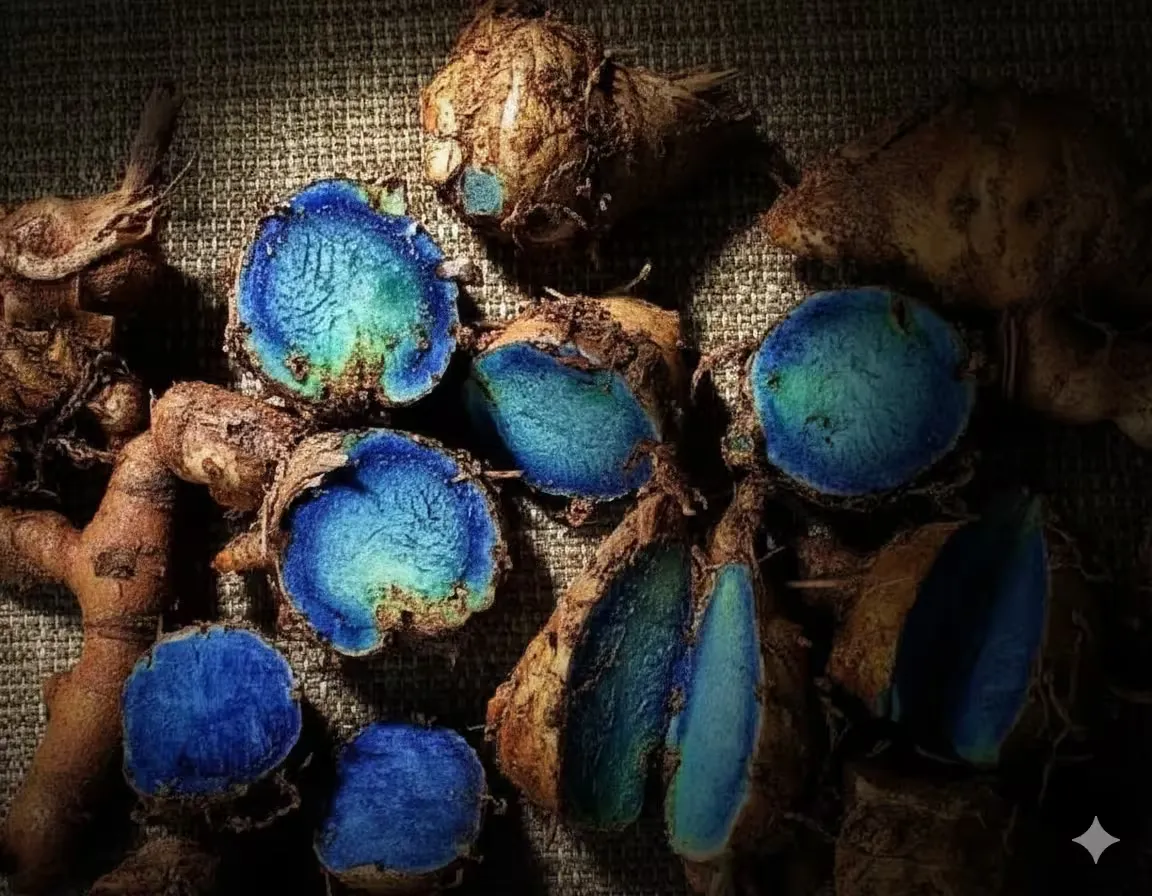
In Siddha medicine, Kaya Kalpa agents are botanicals demonstrated to act on cellular preservation and longevity. Curcuma caesia  black turmeric  is among the rarest and most pharmacologically complex of these.
There is a moment when you first cut a fresh rhizome of Curcuma caesia and the cross-section reveals not the familiar amber-gold of common turmeric, but a deep, bruised blue-black  the colour of a storm about to break. The camphoraceous scent rises sharp and immediate. This is not the turmeric you know. This is its shadow form  rarer, more complex, more guarded in its geography, and pharmacologically distinct in ways that research is only beginning to fully account for.
Curcuma caesia  black turmeric, Kali Haldi in Hindi, Nalla Manjal in Tamil  is a rare and endangered rhizomatous herb from the Zingiberaceae family, native to the forests of northeast and central India, with documented presence in Myanmar and Java. It grows in the wild with a particular preference for the kind of terrain that discourages casual access  forested slopes, humid understories, tribal territories  which may partly explain why it remained peripheral to mainstream botanical commerce even as its cousin Curcuma longa conquered the world. That relative obscurity is now rapidly ending, as scientists begin to characterise what traditional medicine systems in India, Nepal, and Southeast Asia have known for centuries: that this plant is a pharmacological ecosystem unto itself.
The Colour Beneath the Skin
The most immediate question about Curcuma caesia is the one its colour demands: why is it black?
The answer lies in its anthocyanin content. The rhizomes contain 1.3–7.14% anthocyanins  the same class of pigment molecules responsible for the deep colours of blueberries, black rice, and purple sweet potato  and it is these compounds that give the rhizome its characteristic blue-black hue. This is botanically unusual in the Curcuma genus, where most species present yellow or orange rhizomes from curcuminoid pigments. Curcuma caesia carries both curcuminoids and anthocyanins  a rare dual pigment architecture that hints at the breadth of its phytochemical complexity.
The anthocyanins are not cosmetic. They are antioxidant, anti-inflammatory, and increasingly recognised for their role in vascular and metabolic health. Their presence in Curcuma caesia at concentrations several times higher than in common turmeric establishes one of the plant's primary biochemical distinctions before the essential oil profile is even considered.
The Compound Architecture
GC-MS analysis of Curcuma caesia rhizome essential oil reveals a compound profile that diverges significantly from other Curcuma species. The dominant constituent is camphor, present at 28.2%  a monoterpenoid with well-documented analgesic, anti-inflammatory, and antimicrobial properties, and the source of the plant's distinctive sharp, penetrating aroma. Ar-turmerone follows at 12.4%, a sesquiterpenoid shared with common turmeric but present here in a different context and concentration. (Z)-ocimene contributes 8.5%, with additional significant constituents including 1,8-cineole (eucalyptol), borneol, bornyl acetate, ar-curcumene, linalool, zingiberol, curzerenone, and tropolone.
The leaf oil is dominated by 1,8-cineole, camphor, and borneol  a terpene-heavy profile with strong respiratory and antimicrobial implications. The rhizome additionally contains furanodienone and curzerenone, identified as the marker compounds for rhizome quality assessment.
Beyond the essential oil fraction, the rhizome contains curcuminoids, flavonoids, phenolic compounds, alkaloids, and terpenoids including beta-sitosterol. The scarcity of the plant has made comprehensive clinical research difficult. Documented essential oil yields vary from 0.31% to 2.53% per accession across Eastern Indian populations  a significant intraspecific variation with direct implications for therapeutic potency. This is a plant whose biochemical character is shaped by the precision of its terroir, and where sourcing quality determines pharmacological integrity.
What the Research Confirms
Pharmacological studies on Curcuma caesia document a wide and multi-systemic activity profile.
Anti-inflammatory and analgesic activity are the most consistently documented properties, driven primarily by the camphor and sesquiterpenoid fraction. The plant's use in traditional medicine for rheumatic complaints, joint pain, and inflammatory conditions maps directly onto the known anti-inflammatory mechanisms of its major volatile compounds, and has been substantiated in experimental models.
Neuroprotective activity represents one of the more compelling emerging research directions. Ar-turmerone, one of the rhizome oil's primary sesquiterpenoids, has demonstrated neuroprotective properties in preliminary research, with implications for neurological health that align with the plant's classical use in epilepsy and neurological disorders across tribal and folk medicine systems.
Antioxidant capacity is supported both by the anthocyanin fraction and by the phenolic and flavonoid load of the rhizome, with studies confirming significant free-radical scavenging activity  a property fundamental to the plant's classical classification as a cellular protectant and its positioning as a Kaya Kalpa agent.
Antidiabetic effects have been documented in experimental models, consistent with the plant's traditional use in metabolic disorders, with evidence pointing to mechanisms including inhibition of carbohydrate-metabolising enzymes.
Antimicrobial activity against a broad spectrum of bacterial and fungal species is well-established, consistent with the plant's traditional use in wound management, skin disease, and infection  and with the known antimicrobial properties of camphor and 1,8-cineole.
Anti-ulcer activity has been documented in animal studies, consistent with traditional gastrointestinal applications.
Thrombolytic activity  the capacity to support healthy blood fluidity  has been reported, making Curcuma caesia one of the few botanicals with documented activity in this direction from the Curcuma genus, with potential implications for cardiovascular health beyond anti-inflammation alone.
Siddha Medicine: The Shadow's Domain
In the Siddha system of medicine  the oldest surviving medical tradition of Tamil Nadu, grounded in a rigorous understanding of the body as an alchemical terrain  Curcuma caesia occupies a particular category of botanical: the rare, potent, and carefully deployed.
All parts of Curcuma caesia  leaves, roots, rhizomes, and bulbs  are recognised in Siddha, Ayurvedic, and Unani medicine. In Siddha practice specifically, the rhizome's applications extend across several therapeutic domains that reflect the tradition's characteristic understanding of the body's energetic and structural integrity. The plant is used in formulations addressing vatha disorders  the category of conditions associated with nervous system imbalance, movement dysfunction, and dryness  consistent with the plant's neuroprotective and anti-inflammatory activity profile.
Its application in skin conditions including leukoderma reflects the Siddha understanding of the relationship between liver function, blood quality, and skin  a connection that the plant's antioxidant and hepatic activity profile supports biochemically.
The rhizome's camphoraceous quality  its sharp, penetrating, respiratory-clearing character  places it in the category of botanicals used in Siddha to address kapha accumulation in the respiratory tract: bronchitis, asthma, and chronic cough. This use is documented across Siddha, Ayurvedic, and Unani systems simultaneously, driven by the same aromatic essential oil profile.
In Siddha's classification of Kaya Kalpa  the discipline of cellular preservation and systemic rejuvenation, the pursuit of a body that resists the markers of decay  Curcuma caesia is recognised for its rare combination of antioxidant depth, anti-inflammatory reach, and nervous system affinity. It is a plant that works at multiple levels of the body simultaneously, which is precisely the profile that Kaya Kalpa formulation science seeks in its most valued agents.
Tribal Knowledge and the Living Pharmacopoeia
The most intimate record of Curcuma caesia's uses is held not in classical texts but in the tribal communities of northeast and central India, where the plant grows wild and where its applications have been transmitted through unbroken oral traditions.
The Adi tribe of Arunachal Pradesh uses fresh rhizome decoction as an antidiarrhoeal. The Khamti tribe applies fresh rhizome paste for scorpion stings and insect bites. In Chhattisgarh, folk healers apply rhizome paste directly to sprains, contusions, and swellings  a topical anti-inflammatory application consistent with the camphor content. In tribal communities of Odisha, dried rhizome powder decoctions are used for menstrual regulation. Across Manipur, the plant carries cultural and ceremonial significance in addition to its medicinal uses, featuring in ritual contexts where its rarity itself confers a particular value.
This is the pattern of a plant that has been worked with, lived with, and understood through generations of careful observation  not catalogued but inhabited.
Rarity as Signal
Curcuma caesia is currently classified as rare and endangered  the consequence of persistent overharvesting from wild populations combined with habitat loss across its native northeastern Indian range. Market prices for quality rhizome material now range from $37 to $122 per kilogram, depending on provenance and compound profile  figures that reflect both scarcity and demand.
The intraspecific variation across accessions is substantial. Essential oil yield, camphor concentration, anthocyanin content, and the relative proportions of sesquiterpenoids all vary significantly by geography, soil, and microclimate. A Curcuma caesia rhizome from the humid forests of Odisha carries a different compound signature from one cultivated in West Bengal's altered agricultural landscape. Furanodienone and curzerenone  the quality marker compounds  must be present in sufficient concentration for the rhizome to carry full therapeutic value.
This means that sourcing is not incidental to working with black turmeric. It is the core of the practice.
The Shadow's Intelligence
What makes Curcuma caesia genuinely unusual  and genuinely valuable  is the breadth of its multi-systemic action from a single rhizome. Antioxidant depth. Anti-inflammatory reach. Neuroprotective potential. Antimicrobial activity. Metabolic support. Respiratory action. Thrombolytic capacity. These are not scattered, unrelated properties. They reflect a plant that operates comprehensively on the conditions that drive cellular deterioration and systemic inflammation  the same conditions that Siddha's Kaya Kalpa tradition identifies as the fundamental antagonists of longevity and structural integrity.
Common turmeric made the world. Black turmeric stayed in the forest and waited for the science to find it. The science is arriving.
Note: Due to its endangered status, responsible sourcing of Curcuma caesia from cultivated, traceable origins rather than wild-harvested populations is essential for both pharmacological integrity and ecological stewardship.